Have you ever stored opened rice paper for spring rolls or healthy wraps, only to find the sheets fused together into a sticky block, or shattered into tiny brittle pieces? 🫓
Rice paper consists of a delicate starch crystalline matrix derived from rice and tapioca starch, making it exceptionally sensitive to changes in ambient Relative Humidity (RH). High humidity causes moisture absorption, weakening inter-starch molecular bonds, making the sheets soggy, and allowing mold spores to germinate. Conversely, excessively dry conditions disrupt moisture equilibrium, inducing micro-cracking and causing the sheets to crumble easily.
In this guide, we introduce a scientifically proven 3-step rice paper storage guide recommended by food safety experts to prevent both brittleness and sogginess. 🛡️
Food Safety & Scientific Evidence
This content is based on FDA & EFSA & MFDS.
 FreshSelf
Zero waste! Your smart storage assistant
FreshSelf
Zero waste! Your smart storage assistant









1. Scientifically Proven Storage Guide
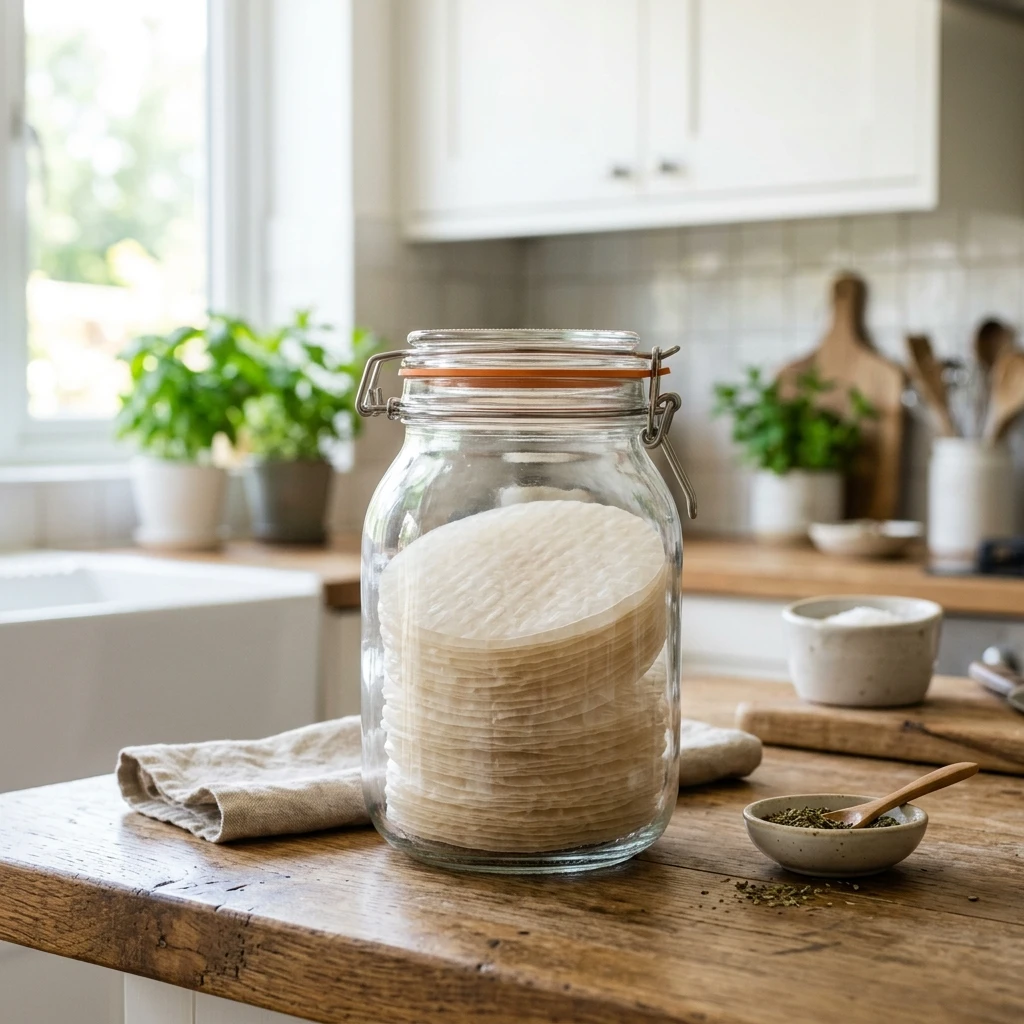
Seal flat in an airtight Ziploc bag after opening — Humidity Barrier & Cracking Prevention 📦
Protecting the starch structure from atmospheric humidity fluctuations is the essential first step. 💡 Storage Tip: Original packaging lets in air once opened. Transfer sheets into a flat, airtight Ziploc bag or hard plastic container without bending, squeeze out air, and seal.
Store flat at cool room temperature (15–25°C) at 50–60% RH — Room Temp Storage (2–3 Years Unopened / 1 Year Opened) 🌡️
Maintaining ideal relative humidity preserves moisture equilibrium in starch molecules. 💡 Storage Tip: Keep in a dark pantry or cabinet away from direct sunlight and stovetops. Unopened packages last 2–3 years; opened sealed sheets stay fresh and intact for up to 1 year.
Never refrigerate — Block Starch Retrogradation & Condensation ❄️
Fridge humidity and temperature drops ruin dry starch matrices. 💡 Storage Tip: Refrigerating rice paper causes surface condensation upon removal, leading to sticking, while cold temperatures accelerate starch retrogradation, making sheets hard and brittle. Keep in a cool room temperature pantry instead.
2. Essential Storage Rules and Cautions
Rice paper is highly hygroscopic. Storing it in high humidity or inside the fridge causes it to absorb moisture, destroying the starch structure, causing sheets to stick together permanently, and encouraging mold.
Storing rice paper bent or leaning upright induces internal micro-cracking within the starch crystalline matrix, causing sheets to shatter at the slightest touch. Always store flat.
📌 Frequently Asked Questions (FAQ)
My rice paper has become dry and brittle. Is there a way to restore it? ▼
Once dry air causes micro-cracking in the starch matrix, sheets cannot be restored to a flexible dry state. However, dipping the brittle sheet into warm water (40–50°C / 104–122°F) for 3–5 seconds triggers immediate starch gelatinization, making it pliable, soft, and completely usable for wrapping.
Opened rice paper sheets have stuck together. Can I still separate and use them? ▼
Sheets sticking together indicates moisture absorption that solubilized surface starch molecules. Pulling them apart dry will tear them. Instead, submerge the stuck bundle into warm water for a few seconds; as water penetrates, sheets will soften and separate smoothly. Discard immediately if mold spots appear.