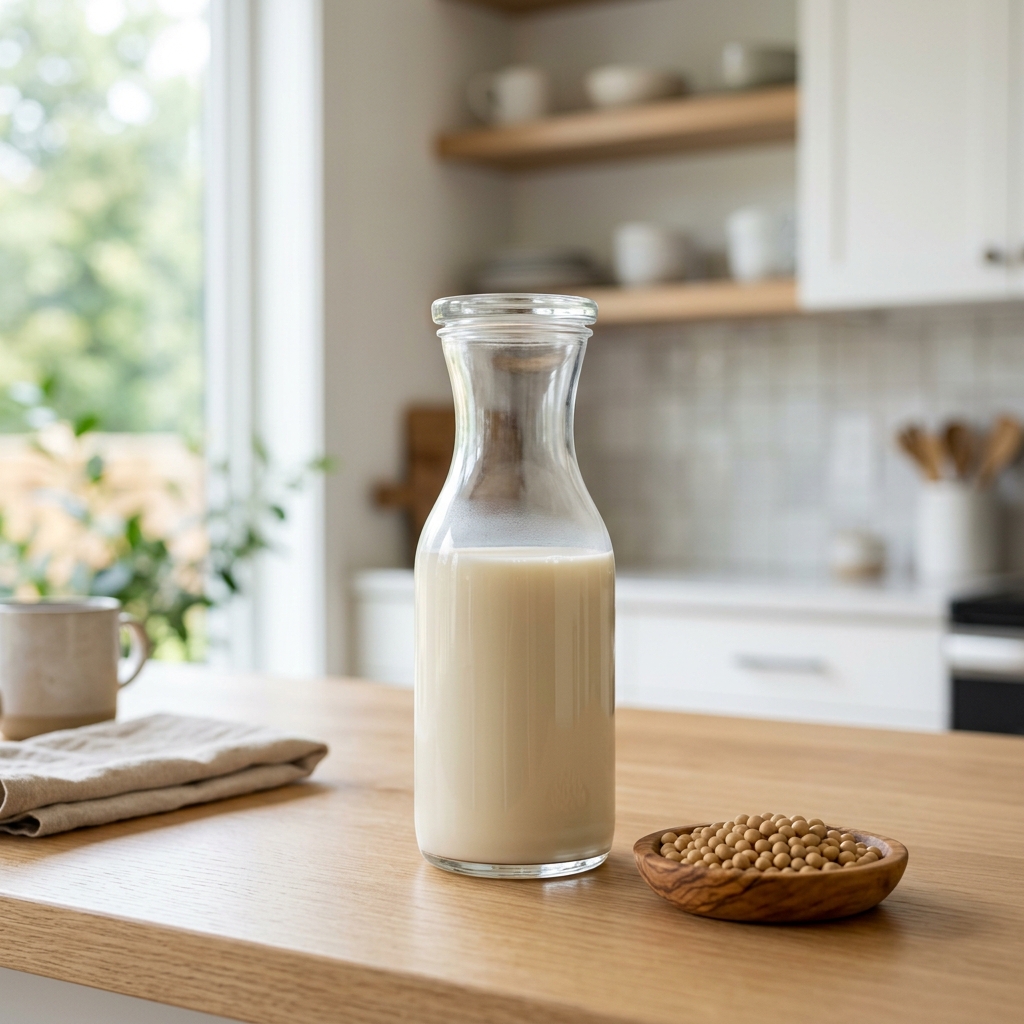
Soy milk is a fragrant, nutrient-rich plant beverage enjoyed by people of all ages! 🥛🫘
Extracted from soybeans, soy milk is packed with plant-based protein, healthy fats, and moisture, making it a cornerstone healthy drink. While unopened aseptic UHT packages can be kept at room temperature, opening the container creates an environment with high water activity (Aw) and rich nutrients ideal for bacterial growth, such as coliform bacteria and Bacillus cereus. If left above 10°C (50°F), acidity rises rapidly, causing protein coagulation where the liquid clumps into curds like soft tofu.
In this guide, based on scientifically verified guidelines from the USDA, FDA, and MFDS, we present a 3-step optimal storage strategy to preserve the nutty flavor and rich nutrients of soy milk. 🛡️
Food Safety & Scientific Evidence
This content is based on USDA & FDA & MFDS.
 FreshSelf
Zero waste! Your smart storage assistant
FreshSelf
Zero waste! Your smart storage assistant






1. Scientifically Proven Storage Guide
Store unopened packages at cool room temperature (15–25°C) — Unopened Storage (Until Expiration Date) 📦
Unopened UHT aseptic soy milk packages can safely be stored at room temperature. 💡 Storage Tip: Keep in a cool place like a pantry away from direct sunlight and heat. Maintaining temperatures below 25°C (77°F) preserves emulsion stability.
Refrigerate immediately at 0–4°C after opening — Opened Cold Storage (5–7 Days) ❄️
Once opened, exposure to airborne bacteria makes cold temperature control essential. 💡 Storage Tip: Store opened soy milk deep inside the main refrigerator body at 0–4°C (32–39°F). Avoid door shelves due to frequent temperature fluctuations. Consume within 5 to 7 days after opening.
Shake gently for 5–10 seconds before drinking — Mix Sediment Evenly 🥛
When left undisturbed, soybean protein and dietary fiber particles naturally settle to the bottom. 💡 Storage Tip: This physical sedimentation is completely normal for high-solids plant milk. Shaking gently for 5–10 seconds redisperses the nutrients for a smooth, creamy texture.
2. Essential Storage Rules and Cautions
Soy milk is rich in protein and fat with high water activity. Leaving it above 10°C (50°F) causes coliform bacteria and Bacillus cereus to multiply rapidly. As bacteria produce acid, rising acidity causes proteins to coagulate into curd-like lumps. Always refrigerate immediately after use.
Freezing soy milk disrupts the emulsion structure of fat and protein particles, completely separating water from solids. Upon thawing, the texture becomes grainy and watery, destroying its smooth, creamy flavor.
📌 Frequently Asked Questions (FAQ)
There is sediment at the bottom and a thin layer at the top. Has my soy milk spoiled? ▼
No, it hasn't spoiled! Settling of soy protein/fiber particles or floating of natural soy fats is a normal physical separation. As long as it smells and tastes normal and mixes well when shaken, it is safe to drink. However, if it forms curdled tofu-like clumps that won't blend, tastes sour, or has a bloated package, it has spoiled and should be discarded.
How long does opened soy milk last if I drank directly from the container? ▼
Drinking directly introduces mouth bacteria and enzymes into the container, causing bacteria to multiply exponentially within hours. Even if refrigerated, consume it within 24 hours. To maximize shelf life (5–7 days), pour soy milk into a cup and reseal the container immediately.