Natural vanilla beans add an exquisite, sweet flavor and aroma to fine desserts and pastries! 🍦✨
Vanilla beans owe their iconic aroma to ‘vanillin,’ a delicate aromatic compound. However, due to their high cost, many people mistakenly store vanilla beans in the refrigerator. Cold refrigeration causes condensation to form on the pods upon temperature changes, drastically increasing surface water activity (Aw) and creating the ideal environment for mold to thrive.
In this guide, based on scientifically verified guidelines from the USDA, FDA, and MFDS, we present a 3-step optimal storage strategy to preserve vanillin crystals and completely eliminate mold risks. 🛡️
Food Safety & Scientific Evidence
This content is based on USDA & FDA & MFDS.
 FreshSelf
Zero waste! Your smart storage assistant
FreshSelf
Zero waste! Your smart storage assistant








1. Scientifically Proven Storage Guide
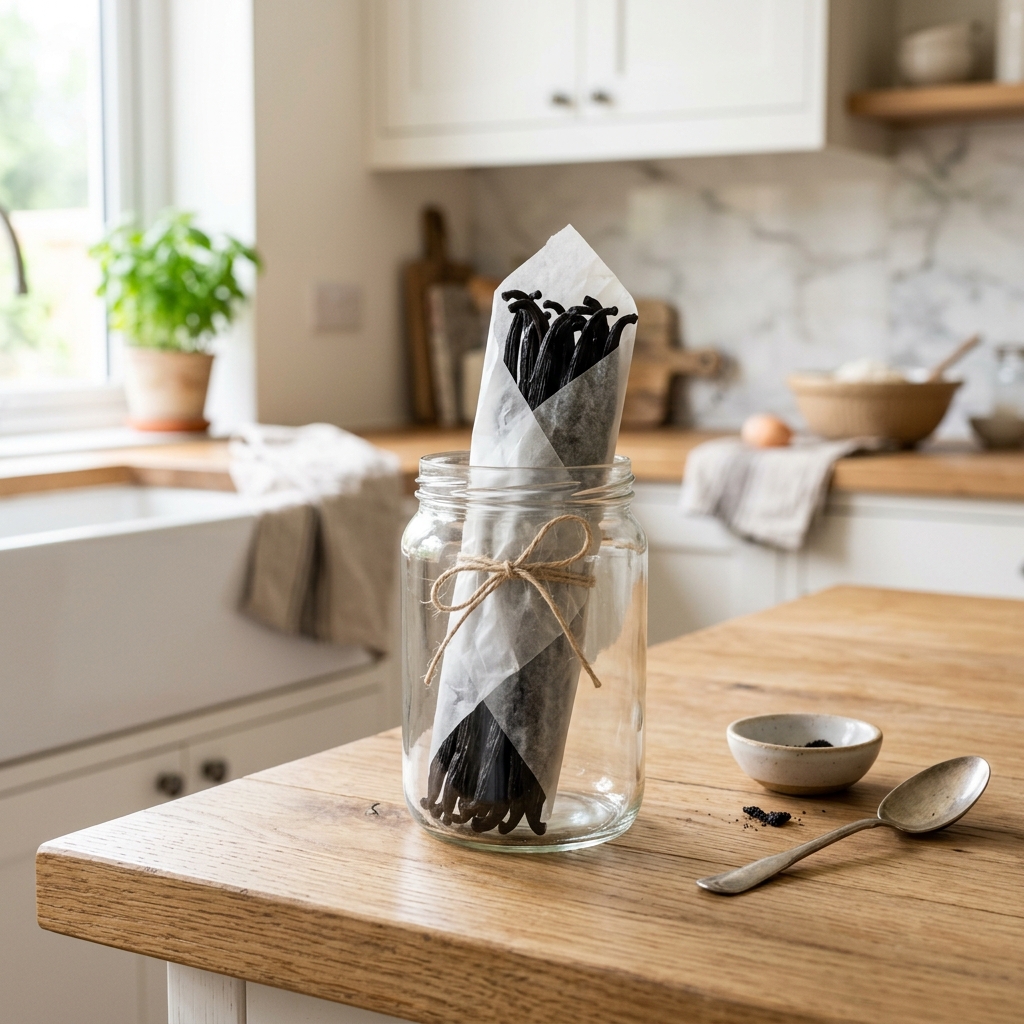
Wrap individual beans tightly in wax paper or plastic wrap — Moisture & Air Barrier 📜
Wrap each vanilla bean in wax paper or food-grade plastic wrap. This minimizes friction between pods and provides a primary barrier against moisture loss.
Store in glass tubes or airtight jars in a cool, dark place (15–18°C) — Optimal Room Storage (1–2 Years) 🫙
Place wrapped beans in narrow glass tubes or airtight glass jars with minimal air headspace. Keep in a cool, dark pantry at 15–18°C (59–64°F) and 60–70% relative humidity. Vanillin remains stable, keeping pods moist and fragrant for 1 to 2 years.
Aerate periodically and repurpose aging beans into extract — Long-Term Use Strategy 🍾
Open the container for 5 minutes every 2 to 3 months to refresh the air and prevent moisture buildup. If pods begin to dry over time, submerge them in 40% ABV vodka or rum to craft homemade vanilla extract or bury them in sugar to make vanilla sugar.
2. Essential Storage Rules and Cautions
Placing vanilla beans in the fridge causes moisture condensation when exposed to ambient air upon retrieval. This spikes surface water activity (Aw), encouraging Aspergillus and Penicillium mold growth while breaking down the delicate vanillin crystal structure.
Leaving vanilla beans unsealed causes essential oils and moisture to evaporate, turning the pliable pods woody, dry, and devoid of their characteristic rich aroma within months.
📌 Frequently Asked Questions (FAQ)
White shiny crystals formed on my vanilla bean. Is it mold? ▼
It is likely not mold! These are often 'vanillin frost' (vanillin crystals), where pure natural vanillin migrates to the surface and crystallizes. Vanillin crystals sparkle under light, smell intensely sweet, and melt upon skin contact. Conversely, if the growth is dull, fuzzy, or smells musty, it is mold and should be discarded.
My vanilla beans became hard and completely dry. Should I throw them away? ▼
Do not throw them away! Dried beans have lost moisture, but their aromatic vanillin remains intact. Simmer them in warm milk/cream for custard, or submerge them in high-proof vodka or rum for 2–3 months to create rich homemade vanilla extract.