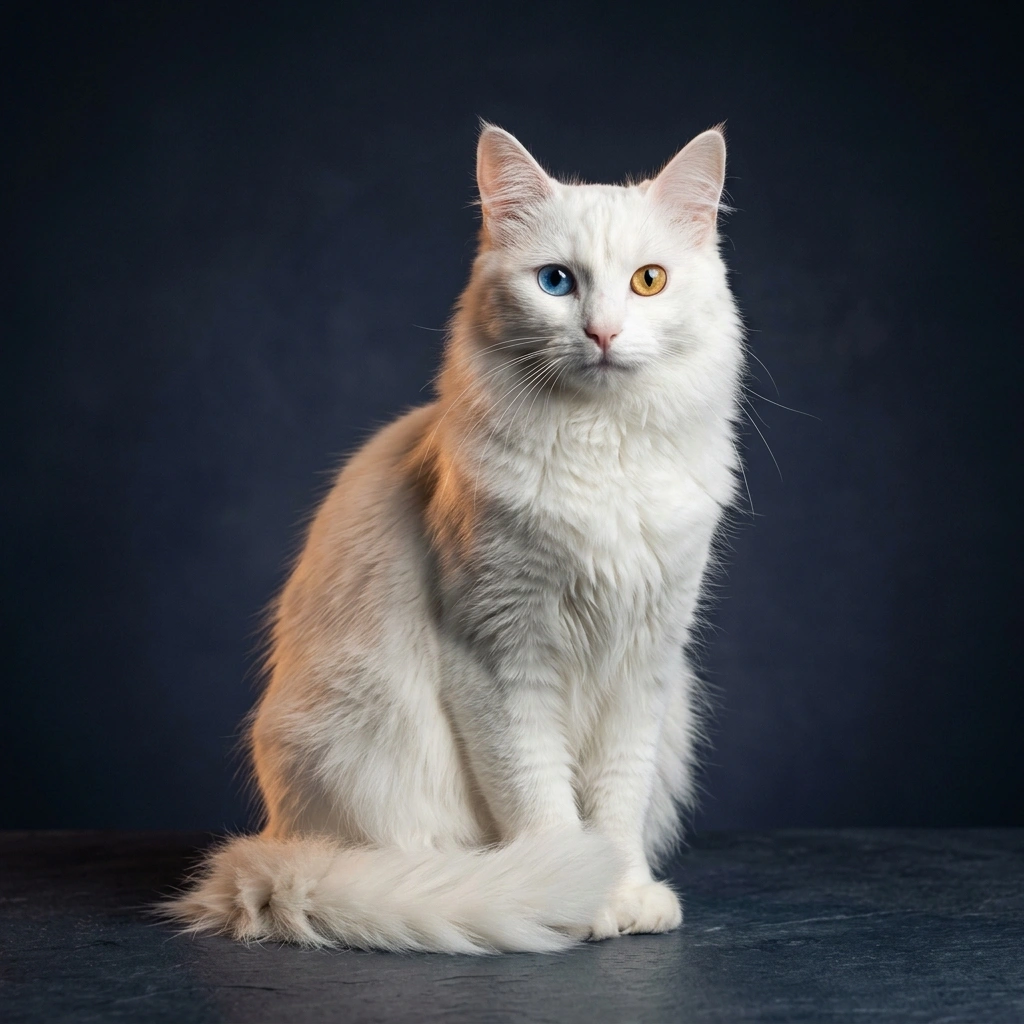
Boasting elegant, silky single coats and striking eyes, Turkish Angoras are highly active and intelligent felines. However, white Turkish Angoras with blue eyes or odd eyes have a very high rate of congenital sensorineural deafness associated with the dominant white gene ($W$). Additionally, cardiac screenings for hypertrophic cardiomyopathy (HCM) are recommended as they mature. In this guide, decodes Turkish Angora deafness behaviors and provides a 3-step daily care routine using visual and vibrational signals to keep them safe and bonded.
Veterinary & Behavioral Evidence
This content is based on Cat Fanciers' Association (CFA) Turkish Angora Breed Council & Veterinary Deafness Studies.
 FreshSelf
Keep pet food and supplements perfectly fresh!
FreshSelf
Keep pet food and supplements perfectly fresh!









1. Turkish Angora Body Language: Deafness Signs and Vibration Sensitivity
Turkish Angora Body Language: Deafness Signs and Vibration Sensitivity
Deaf cats display unique behaviors such as 'unmodulated loud vocalization' because they cannot monitor their own vocal volume and feel frustrated trying to communicate. Instead, they rely heavily on sensing 'floor vibrations' through their paw pads. Understanding these adaptations prevents startling them and avoids fear-induced aggression.
2. Turkish Angora’s Body Language & Behavioral Signals
Loud Unmodulated Vocalization
Meowing very loudly or screaming into the air without acoustic volume control, driven by hearing loss and a desire for interaction.
Avoid startling them from behind. Approach from within their direct field of vision using gentle hand gestures or visual cues.
Floor Vibration Sensitivity
Using paw pads (Pacinian corpuscles) to detect subtle mechanical vibrations through the floor to track approaching people or objects.
Gently tap the floor or wall with your foot or hand before walking nearby so they sense your presence in advance without panic.
3. Customized 3-Step Home Care Routine for Turkish Angora
Morning: Visual Greeting & Positive Hand Sign Training
Say good morning using friendly hand signals and slow blinks rather than verbal calls, creating a calm, stress-free morning ritual.
Afternoon: High Vertical Space Setup and Safety Fall Check
Provide sturdy cat trees and shelves for this climbing breed, but ensure padding and fixations are secure, as deafness can occasionally impair spatial balance.
Evening: Single-Coat Grooming to Prevent Tangles and Hairballs
Gently brush their fine, silky single coat daily with a pin brush. Although they lack a dense undercoat, their fine long fur entangles easily and forms hairballs.
📌 Frequently Asked Questions (FAQ)
Are all white Turkish Angoras with blue eyes or odd eyes deaf? ▼
Not all, but white cats with blue eyes have an extremely high probability (60–80%) of congenital deafness due to the dominant white gene ($W$). Odd-eyed cats (one blue eye) often experience unilateral deafness on the side corresponding to the blue eye.
How can I make my home safe for a deaf Turkish Angora? ▼
Maintain a 100% strictly indoor environment, as deaf cats cannot hear external hazards like vehicles or dogs. Install double safety nets on windows and doors, and always signal your presence through floor vibrations before touching them.