Have you ever bought a whole head of cabbage and put it in the fridge, only to find the cut surface turning black and withered, forcing you to throw half of it away? 🥬
Even after being harvested, cabbage continuously draws water and nutrients from its outer leaves through its thick central core to keep growing. If the core is left intact, moisture evaporates rapidly from the inside out, making the leaves limp and accelerating rot.
In this guide, shares a scientifically proven 3-step storage guide based on research from the RDA and USDA to unlock the secret of the cabbage core, keeping your cabbage crisp and fresh for up to 30 days. 🛡️
Food Safety & Scientific Evidence
This content is based on RDA & EFSA & FSA.
 FreshSelf
Zero waste! Your smart storage assistant
FreshSelf
Zero waste! Your smart storage assistant







1. Scientifically Proven Storage Guide
Carve out the core in a triangular cone shape — Block Nutrient Loss Path 🔪
The central core serves as a growth center that drains moisture and nutrients from outer leaves post-harvest. 💡 Storage Tip: Use a sharp knife tip to carve out the core deeply in a triangular cone shape. Removing the core eliminates the primary site where spoilage begins.
Stuff the core cavity with a damp paper towel — Continuous Hydration Patch 📰
The carved core cavity becomes a direct portal to hydrate the cabbage cells. 💡 Storage Tip: Moisten a paper towel (squeeze out excess dripping water) and roll it into a dense ball to stuff tightly inside the carved cavity. This delivers continuous moisture to the cut stalk, preventing drying and browning.
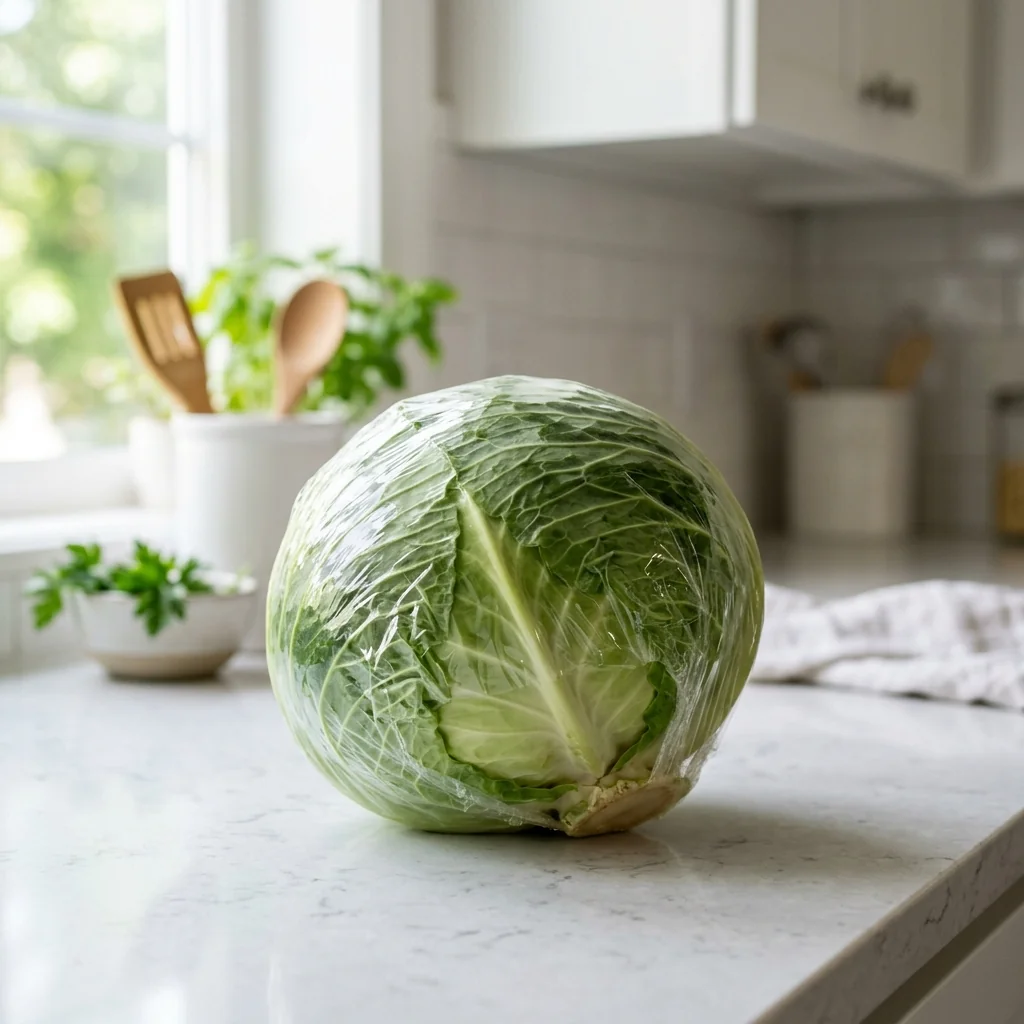
Wrap tightly with plastic wrap and store core-side down — Cold Storage (21–30 Days) ❄️
Blocking air contact and water evaporation is vital to maximizing shelf life. 💡 Storage Tip: Wrap the entire cabbage tightly with multiple layers of food-grade plastic wrap. Store it in the refrigerator crisper drawer (0–4°C) with the damp core patch facing downward so moisture settles evenly.
2. Essential Storage Rules and Cautions
Leaving the damp paper towel stuffed inside the core cavity for over a week can trap moisture, causing bacteria or mold to breed and creating a sour odor. For optimal hygiene, replace it with a fresh, damp paper towel every 5 to 7 days.
Leaving cabbage at warm room temperatures (above 15°C / 59°F) increases its respiration rate, causing the outer leaves to loosen and moisture to evaporate rapidly. Always store cabbage in the cold crisper drawer (0–4°C) to maintain crispness.
📌 Frequently Asked Questions (FAQ)
The cut surface of my cabbage turned dark brown/black. Is it still safe to eat? ▼
Yes, it is completely safe. The darkening of the cut surface is a natural enzymatic reaction (browning) when polyphenols react with oxygen in the air. It is non-toxic. Simply slice off a thin layer of the browned surface with a knife, and the crisp, fresh cabbage inside is ready to eat.
How should I store half-cut or shredded cabbage? ▼
For half a head of cabbage, lightly brush the cut surface with diluted lemon juice or vinegar, then wrap tightly in plastic wrap to block oxygen. Shredded cabbage loses moisture rapidly and is vulnerable to bacteria; store it dry in an airtight container lined with paper towels and consume within 3–5 days.