Have you ever washed raw chicken under the tap, only to worry about spreading foodborne bacteria around your kitchen sink? 🍗
Raw poultry has a high moisture content and delicate muscle fibers, making it an ideal breeding ground for harmful foodborne pathogens like Campylobacter jejuni and Salmonella. Washing raw chicken under running water causes micro-droplets containing bacteria to splash onto nearby countertops, utensils, and food.
In this guide, shares a scientifically proven 3-step poultry storage guide based on hygiene guidelines from the CDC, USDA, and MFDS to prevent cross-contamination and keep your chicken safe, tender, and fresh. 🛡️
Food Safety & Scientific Evidence
This content is based on USDA & MFDS & CDC.
 FreshSelf
Zero waste! Your smart storage assistant
FreshSelf
Zero waste! Your smart storage assistant







1. Scientifically Proven Storage Guide
Never wash raw poultry with water — Prevent Sink Cross-Contamination ❌💧
Washing raw chicken splashes microscopic droplets containing Campylobacter or Salmonella up to 50 cm (20 inches) around the sink, contaminating dishes and surfaces. 💡 Storage Tip: Never rinse raw chicken with water. Instead, gently pat the surface dry with paper towels or blanch it briefly in boiling water to sanitize before cooking.
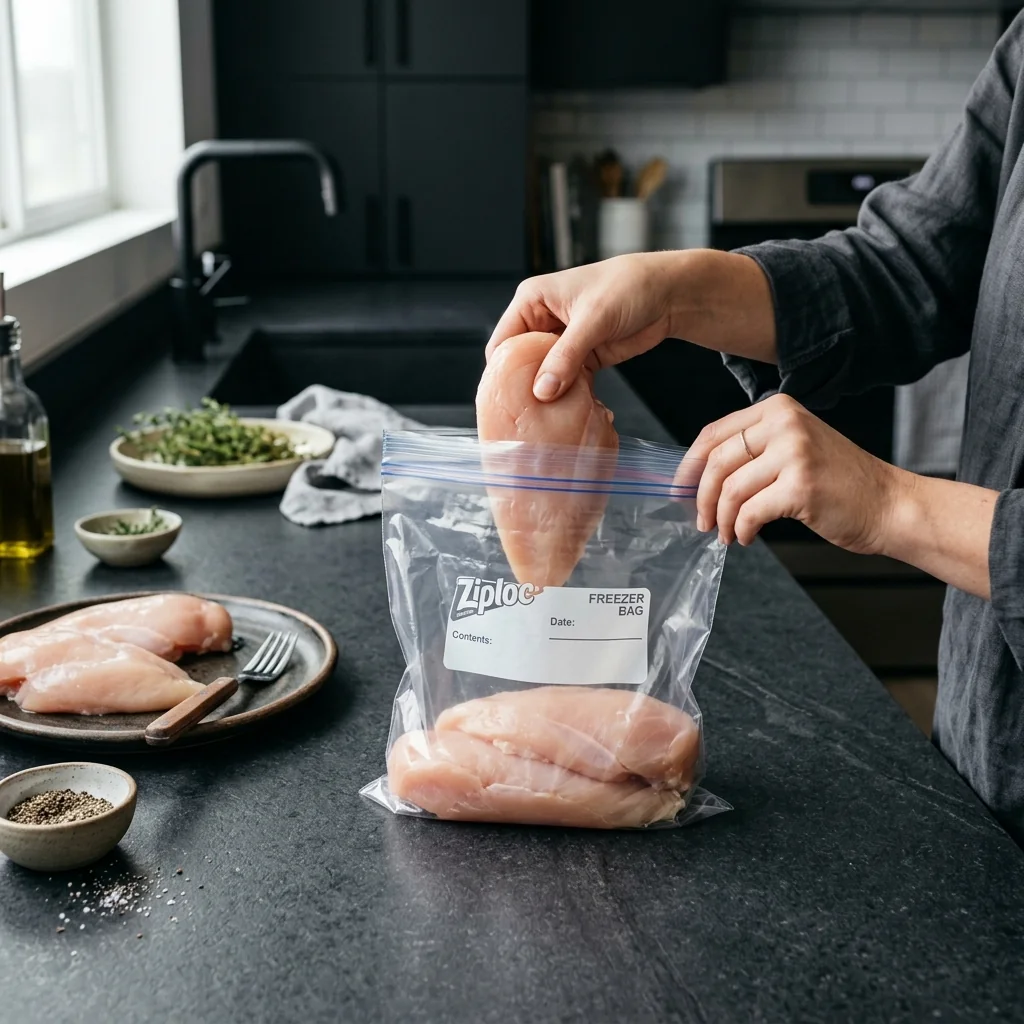
Double-seal in Ziploc bags and store on the bottom shelf — Cold Storage (1–2 Days) 📦
The raw red juice (drip) leaking from poultry contains high bacterial loads that contaminate other cooked or fresh foods upon contact. 💡 Storage Tip: Place chicken in its tray into a Ziploc bag for double sealing. Store it on the coldest, most stable bottom shelf (0–2°C) of the fridge to prevent dripping.
Pre-season lightly with salt and cooking wine or freeze — Frozen Storage (90 Days) ❄️
If you cannot cook raw chicken immediately, pre-seasoning or rapid freezing extends its safety window. 💡 Storage Tip: To extend fridge life by an extra day, sprinkle lightly with coarse salt and cooking wine/sake; alcohol provides antimicrobial action while salt firms up muscle tissue. For longer storage, wrap single portions in wrap and freeze below -18°C.
2. Essential Storage Rules and Cautions
Knives and cutting boards used for raw chicken harbor invisible pathogenic bacteria. Sanitize them immediately with hot water (above 75°C / 167°F) or dish soap after use, and never use the same utensils to slice raw vegetables or salads.
Chicken has higher water activity and softer muscle tissue than pork or beef, allowing bacteria to multiply much faster. Limit refrigerator storage (0–4°C) to a maximum of 48 hours, and freeze (-18°C or below) any portion you will not eat right away.
📌 Frequently Asked Questions (FAQ)
What is the scientific reason for NOT washing raw chicken before cooking? ▼
Raw poultry surfaces can harbor foodborne pathogens like Campylobacter or Salmonella. Rinsing raw chicken under tap water creates aerosolized micro-droplets that splash bacteria onto your sink, counter, and nearby food, causing severe cross-contamination. Thorough cooking to an internal temperature of 74°C (165°F) completely destroys all bacteria safely without rinsing.
Why does raw chicken have a shorter refrigerator shelf life than beef or pork? ▼
Chicken muscle fibers are much finer and softer, combined with a higher moisture content (water activity) that provides an optimal environment for bacterial proliferation. Because spoilage and pathogenic bacteria multiply rapidly even at 0–4°C, raw poultry should be consumed within 1–2 days or frozen immediately below -18°C.